The story of how I affirmed my superficial self and my art was born
Updated: May 6
Today, I thought I’d jot down a few rambling thoughts about why I work with stippling.
Above all, I believe art is not something you simply learn. It’s something that makes you think, something you enjoy through the process itself, and ultimately, something through which you come to know yourself.
While I work within a fairly specific technique, I also believe that there should be no limits on what one chooses to express beyond technical point of view. As a result, my drawings don’t always have much restraint or consistency. One day I might be drawing a portrait of Lemmy Kilmister, and the next I could be drawing a Japanese hostess.

And yet, through my daily practice, I am still in the process of learning about who I am.
In this blog, I plan to quietly and irregularly share these little ramblings of mine from time to time.
My attachment to superficiality
The drawings I make are very graphic.

When I try to express that in Japanese, something like ‘visually driven’ or ‘superficial,’ though that word usually has negative connotations.
I originally trained in sculpture, and people are often surprised when I tell them that. Sculptors’ drawings typically have a strong sense of volume and depth. Mine are closer to something graphic. In fact, since I also work in graphic design, I think of my drawings as something like hand-drawn graphics.

Even back when I was a student, in sculpture classes, once I had established a certain basic form, I found myself far more drawn to manipulating the surface texture in my own way than to the more essential sculptural process of refining the form further. Teachers would always pointed that out to me— but I just couldn’t stop the habit. That process was what put me into “the zone.”
When it comes to the kind of art I love, I’ve always been more drawn to ukiyo-e(*1) than to sculpture, and I was especially captivated by the posters of Tadanori Yokoo(*2). Compared to art from the same periods in other countries, ukiyo-e and traditional Japanese painting feel overwhelmingly meticulous and refined—their delicacy and expressive power never fail to move me.

*1: The most famous Ukiyo-e by Hokusai Katsushika

Painting by Oi Katsushika, a daughter/his first assistant of Hokusai
Graphic design, poster art, and illustration feel to me like something in between fine art and fashion. They spark a sense of childlike wonder and playfulness, yet at the same time they possess a kind of sophistication that I deeply appreciate.

*2: A poster art of Tadanori Yokoo
And then there’s the fact that I grew up in Japan reading manga(comic). There’s no doubt that it shaped me. Not only as a kid, but even as a teenager, I was deeply absorbed especially in horror comic and alternative, subcultural works like those published in Garo.
I don’t know if it’s still the case now, but in the Japanese fine art scene, there was a certain atmosphere that didn’t quite recognize manga as “art.” Personally though, I believe manga is something Japan can truly be proud of—a fully original art form.
While anime has gained global recognition and its status has risen over the past fifteen years or so, I feel that manga deserves more recognition as well. The sheer range and diversity of Japanese manga is remarkable, and its ability to draw you completely into its world is extraordinary.

Uzumaki by Junji Ito

Zouroku No Kibyou (Zouroku's rare disease) by Hideshi Hino

Binzume No Jigoku (Hell in a bottle) by Maruo Suehiro

Nejishiki (Screwed) by Yoshiharu Tsuge (right)
I’m also deeply drawn to things like the soft, delicate texture of flower petals, the beauty of an animal’s fur or eyes, the strange patterns of marine life, droplets of water clinging to a spider’s web, or the deep wrinkles on an elderly person’s face.

The surface reveals what lies beneath.
But it’s not something as simple as saying that a healthy mind makes for beautiful skin.
Expression, personality, inherent nature, the passage of time a person or object has lived through, and the environment surrounding them —all of these elements intermingle and emerge on the surface as texture.
Rather than judging these qualities in binary terms of good or bad, I want to take the stories and emotions that unfold within me when I encounter them, and combine them with my central theme of “yin” and “yang” to express them outwardly into the world.
It’s from this impulse that I create my work.

Facing complexity and art
For many years, I saw my own “surface-oriented” tendencies as something negative. Part of the reason I deliberately chose to study sculpture was because I wanted to “fix” that.
By the time I entered college, I had learned to grasp form more accurately, and my technical insecurities had largely been resolved. But what I realized there was this: I still loved surfaces and two-dimensionality.
After graduating and moving to New York, I ended up working in fashion ―a field that represents the very extreme of “superficiality”.
Everything I saw and experienced felt new and exciting, and those hectic, overstimulating days felt like an endless party.
I truly enjoyed that time, but after nearly ten years away, a desire began to grow in me —not to create under someone else, but to make my own art.

For the past years, I’ve been creating illustrations and drawings that sit somewhere between art and fashion, while also working in graphic design.
I express the sense of “beauty” I feel —including transience and even grotesque beauty— through tiny, microscopic “dots,” connecting each one to form a single image. This technique of stippling allows me to fully explore my own obsession with surfaces.
Each individual dot gathers with others to create shadows, tones, and eventually a complete image. Because of that, the process becomes a kind of training in focusing on the present —carefully attending to each and every dot.
The act of placing a dot is the smallest possible unit of action, and it demands full attention. It’s not a method suited to impulsive people. If you draw “casually” or without focus, the result rarely turns out well.
In stippling, concentrating on the present moment (placing each dot) is what leads to a future you can be satisfied with (the finished work). I feel that this way of working also connects to how we live.
It’s extremely time-consuming and almost painstaking process, but when I fall into the rhythm of building my world little by little, moment by moment, it becomes deeply satisfying.
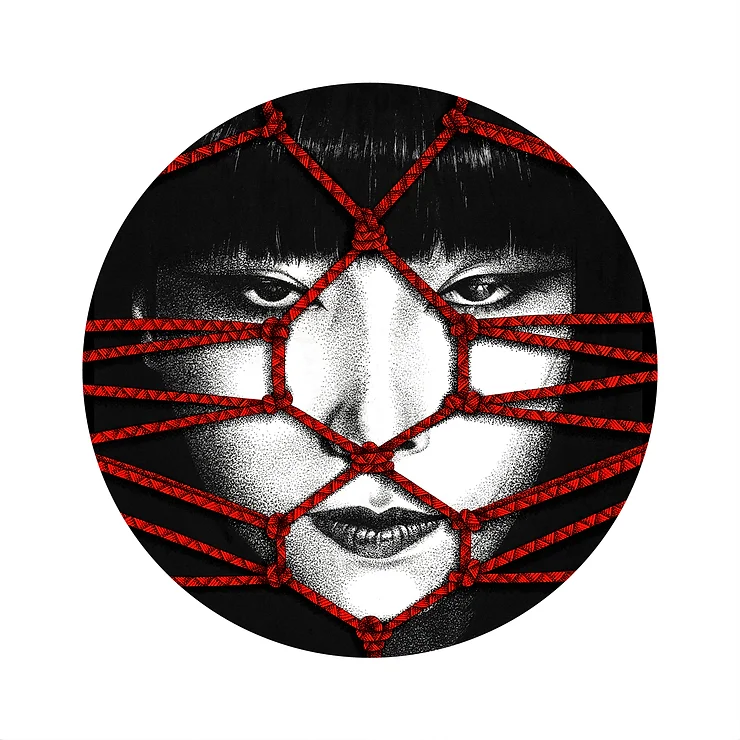
A mindset to turn my complexity into a strength by daring to pursue it
For me, drawing(and creating graphics from my own work) is also a form of therapy. Through it, I can transform my obsession with surfaces into something positive.
By honestly accepting this “surface-oriented” aspect of myself, I’m able to process that complex and reshape it into something I find beautiful.
Regardless of whether people like my work or not, over the past few years, through small, gradual changes, I feel that my style has slowly become something uniquely my own. All forms of expression evolve alongside personal growth and change, so I’m excited to see how my work will continue to develop.
Creating is life itself. And life is something to be enjoyed after all.
As someone who struggles with competition and also with fitting into like-minded communities, I’ve always felt a bit out of step with society. But art gives me freedom and the peace of knowing I can be exactly who I am.
I want to keep living this way, enjoying the process and pursuing what I uniquely love.

Comments